As I said in the last post, I participated in the Okihikigyōji (御木曳行事) as part of the Shikinen Sengū (式年遷宮) at Isë Jingū (伊勢神宮) on June 13th. That post explains what that is, and this post is about my experience of it.
There were about 30 of us in the group from Jinja Honchō, including the entire International Section and a reporter from Jinja Shinpō, so I expect there to be an article about the event, although I do not need to consult it this time. Most of us went by shinkansen and train from Tokyo, although a couple of people who live in western Japan joined us at Isë. The seminars were on the 12th, and the event itself was on the 13th.
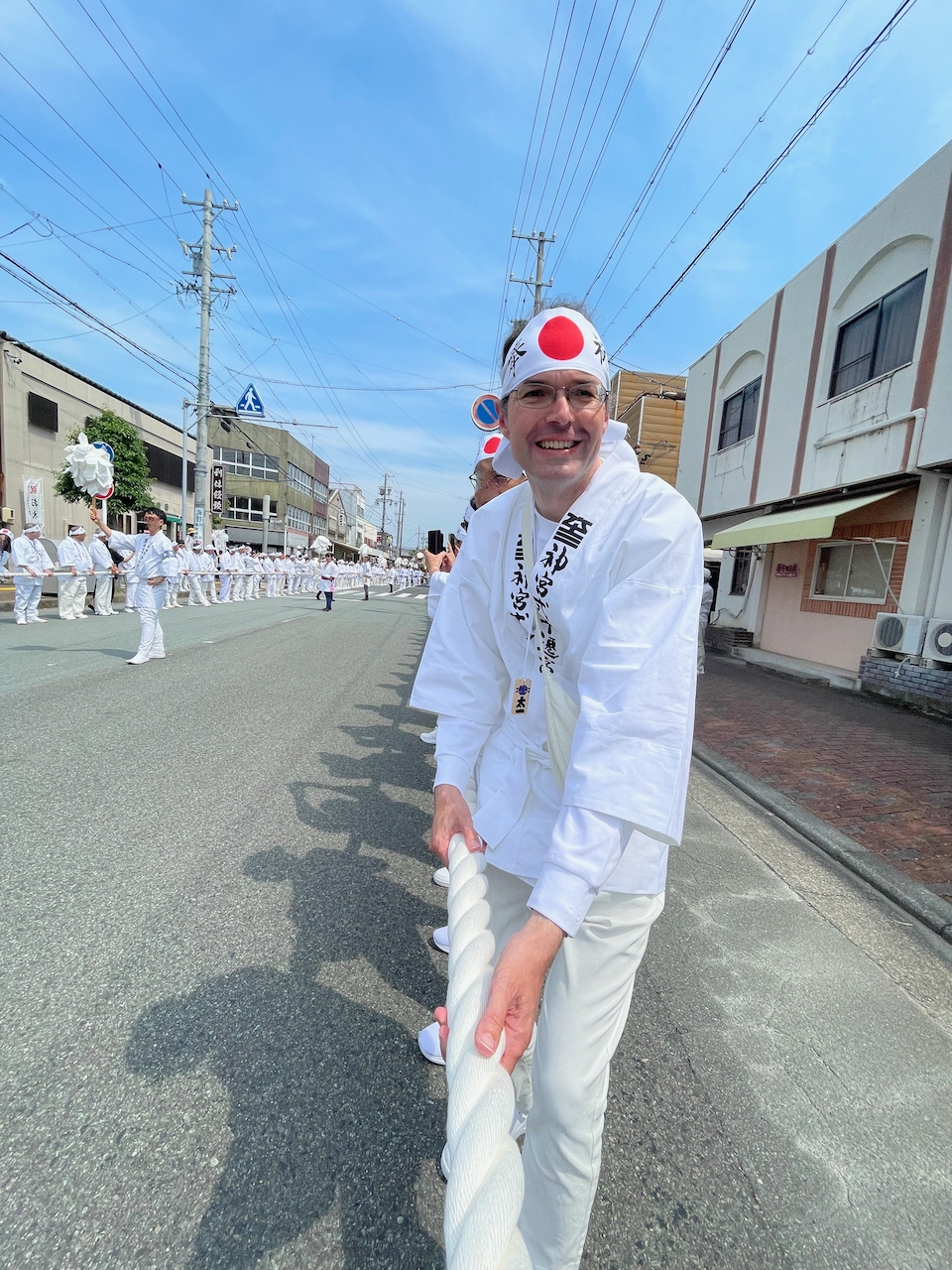
In order to participate, we had to dress entirely in white: white top, white trousers, white shoes, white socks, and a white bag if you wanted to carry anything. We were also provided with happi jackets and hachimaki (headbands) — you can probably guess the colour. Or you could just look at the photograph. We were staying in Futami, which is right on the coast, and in the morning we were encouraged to pay our respects at Futami Okitama Jinja, where people visiting Jingū traditionally purified themselves before going to the sanctuaries. I did, of course.
Two wagons were being pulled that day, and we were assigned to the second one. That was the last of this year’s Okihikigyōji, and we were encouraged to provide a good close to the event. We all received little wooden tags, which served several purposes. First, they show that you are an authorised participant. Second, they have a colour on them to tell you where to line up. Third, the colour of the string tells you which rope you will pull. Finally, they are good souvenirs… We had almost perfect weather for it. (“Perfect” would have been just a little less sunny — but just a little.)
The whole thing was very well organised, as it needs to be. There were just under 700 people pulling our wagon, and I think that is the normal number. The ropes are about 200 metres long. We were quite near the back, near the wagon itself, and you can see the end of the log, which has a white cover, if you look carefully at the photograph. There were a lot of volunteers from Isë, about 400 if I recall correctly, and they covered a wide age range, from probably high school to people who made me think that maybe I would be able to participate the time after next as well. The people from outside Isë were mostly older, but as you really had to arrive on Friday to participate on Saturday, I imagine that participation would be difficult for people of working age. (We had some younger people in our group, but they were working.)
Everyone was gathered in front of the wagon, and we had speeches of encouragement from the man running it, the prefectural governor, and the local Diet member (MP). Then people were arranged into two lines going 200 metres down the road. Once everyone was lined up, the (white) ropes were passed out. Everyone in line had to help pass the rope along, because one person at the front could not pull that much rope that far. When the rope reached the start of the line, we all took hold, and moved out towards the sides of the road.
The people who would sing the “Kiyariuta” (木遣り歌) — “Tree sending songs” — lined up in the middle, between the ropes. We had been taught the responses to the choruses in the initial gathering, and we had a quick practice before moving off.
When the wagon is pulled, the friction of the wheels and the axle produces a continual low drone. This is a very pleasant sound, but very hard to describe. Apparently, the carpenter has to be very skilled to get this to work, but we must have had a good one on our wagon. While the wagon and log together weigh about four tonnes, there are about 350 people on each side, and so one does not have to pull quite as hard as you might think. The exception is when you are going around corners, and have to pull sideways to keep the rope on track.
While you are pulling, there is a constant call and response, with the response being “en-ya!”. The Kiyariuta performers also walk up and down the middle, encouraging everyone to shout, and generally keeping things lively. We stopped a couple of times along the route, partly so that everyone could rest, and partly for performances of the Kiyariuta. Each verse was sung by a different individual, and they had microphones, but everyone took up the choruses, including those of us who were pulling. Most of the performers were young(er than me), and the youngest may have been in or just out of high school.
It takes about an hour to pull the wagon the one kilometre to the north entrance of the Outer Sanctuary, but it really doesn’t feel like it. (It feels shorter, not longer.) There are people assigned to deliver small bottles of sports drinks (and collect the empties) all along the route, and cold water is provided when you arrive at the sanctuary, to avoid dehydration and heatstroke. Then everyone goes to pay their respects to Toyoukë Ōmikami at the Outer Sanctuary. That also takes some organising, because there were (as mentioned) about 700 of us. Dozens of volunteers made sure that both we, and regular visitors, could pay our respects. The people who had pulled the log were taken into the outermost compound of the sanctuary to pay their respects. This is “normal special”, if you like. Not just anyone can do it, but it is very easy to qualify — any member of the Sūkeikai (Adherents’ Association) can do it, for example.
While it has finished for this year, it all happens again next year — and then not again until 2046. You may be wondering whether you could participate. In principle, yes. There is no bar on foreigners participating — one member of our group was not Japanese. In practice, however, you need a connection to a group that is going. If you live in Japan and want to participate, ask at your local jinja. They may be going, and if they are not, they might be able to connect you to the prefectural Jinjachō. You can also participate through the Sūkeikai, but I get the impression that their slots fill up very quickly, and you can only book by phone, on a particular day. You do need to speak good Japanese to follow all the instructions on the day, as well as manage the arrangements. If you live outside Japan, it is probably not possible, in purely practical terms.
I am very glad that I had the opportunity to participate — it was a very special experience. I thought this would be my last chance, but having seen the other participants, maybe I will be able to do it next time as well.
Looks like you were having fun! Unfortunately, the only thing we were having in the UK was a heatwave. I gifted one of my friends your introduction to Shintoism a while back and he really enjoyed it. I’m looking forward to your future books and posts!
Take care!
Thank you!